1. Understanding Fiber Cord Geometry
Modern macramé relies on high-grade natural cordage. Using synthetic nylon causes knots to slip under tension, while low-grade twisted strings shed debris and fray unevenly. The standard benchmark is 4mm 3-ply unbleached cotton rope.
The cardinal rule of macramé estimation is the 4X to 6X Multiplier Formula: For every 1 meter of desired finished woven length, cut 4 to 6 meters of working cord depending on whether your design relies primarily on open sennits (4X) or dense diagonal clove hitches (6X).
2. Foundational Knot Anatomy
All complex geometric tapestries derive from three structural knotting archetypes:
- Larks Head Knot: The mounting anchor used to fix looped cords onto the supporting hardwood dowel or driftwood limb.
- The Balanced Square Knot (SK): Alternating left-facing and right-facing half-knots around two stationary core filler cords.
- Diagonal Double Half Hitch (DHH): The defining knot for creating crisp architectural diagonals, diamonds, and chevron ridges across a leading guide cord.
Tension Uniformity Rule
Always hold your passive guide cord taut at the exact 45° angle of your intended line. Never pull the guide cord through the working cord loop; pull the working cord tight around the immobile guide.
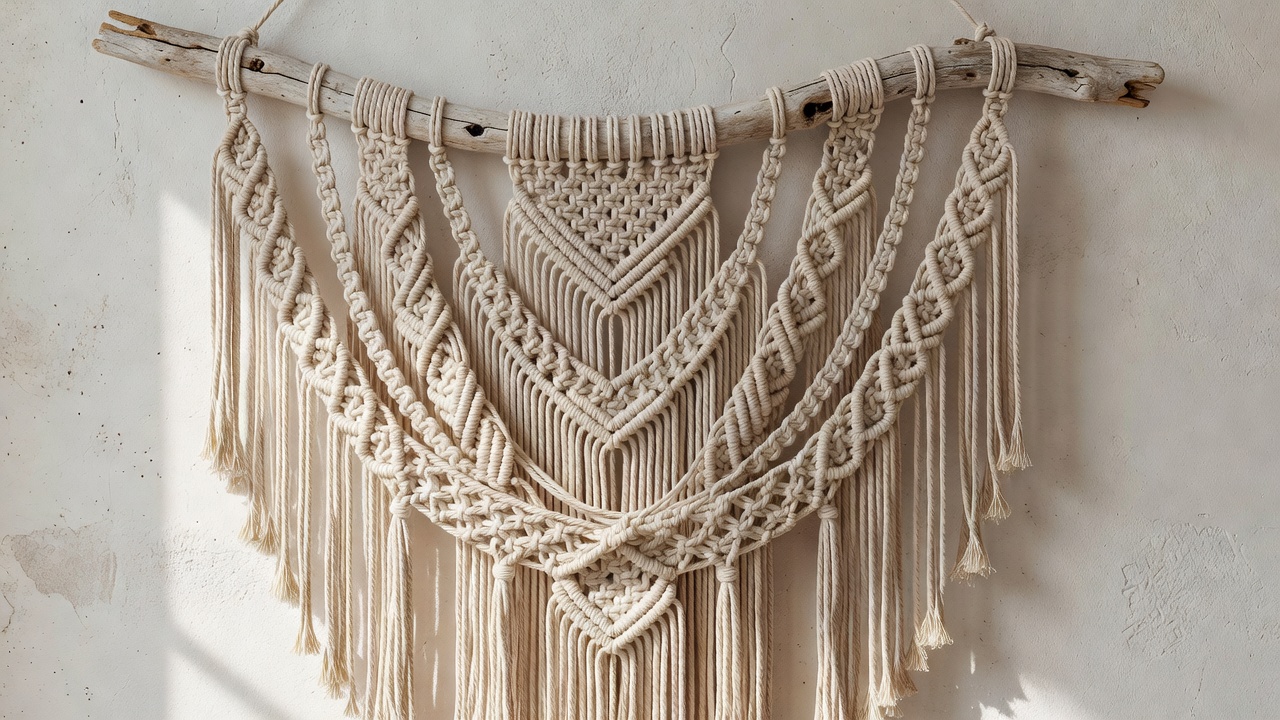
3. Blueprint: The Chevron Diamond Tapestry
- Mounting: Cut 16 lengths of 4mm 3-ply cotton cord, each 4.5 meters long. Mount each cord onto a 60cm oak dowel using inverted Lark's Head knots, giving you 32 working strands.
- Central Diamond Apex: Separate cords into two groups of 16. Take strand #16 as the right-to-left guide cord and strand #17 as the left-to-right guide cord. Execute 7 Double Half Hitches outward toward each wing.
- Filler Pattern: In the hollow center of the diamond, construct a graduated 3-2-1 pyramid of alternating square knots.
- Closing the Apex: Direct the outer guide cords back inward toward the centerline at a matching 45° angle, knotting the final two guide cords together with an overhand locking knot.
4. Finishing, Fringe Steaming & Shaping
| Stage | Tool | Technique |
|---|---|---|
| Fringe Trimming | Tailors Rotary Cutter & Acrylic Ruler | Tape fringe securely against a cutting mat; slice with 45mm rotary blade for laser-straight bottom edges. |
| Fiber Brushing | Stainless Steel Pet Slicker Brush | Gently comb the cut 3-ply strands starting from bottom tips, working upward to prevent knotting. |
| Steam Relaxing | Garment Steamer | Pass steam wand 3cm from brushed cotton to relax natural kinks without soaking the fibers. |
For more home studio workshops and step-by-step fiber guides, continue exploring our Complete Project Catalog.